General Terms and Conditions (GTC) of the check-in/check-out (CICO) feature in the Zurich Transport Network (ZVV) app
Below you will find the general terms and conditions of the Check-in / Check-out (CICO) function in the app of the Zurich Transport Network (ZVV).
I. Applicability
These General Terms and Conditions (GTC) apply specifically to the use of the CICO feature and the purchase of electronic tickets issued by Fairtiq AG on behalf of the ZVV.
II. Functionality
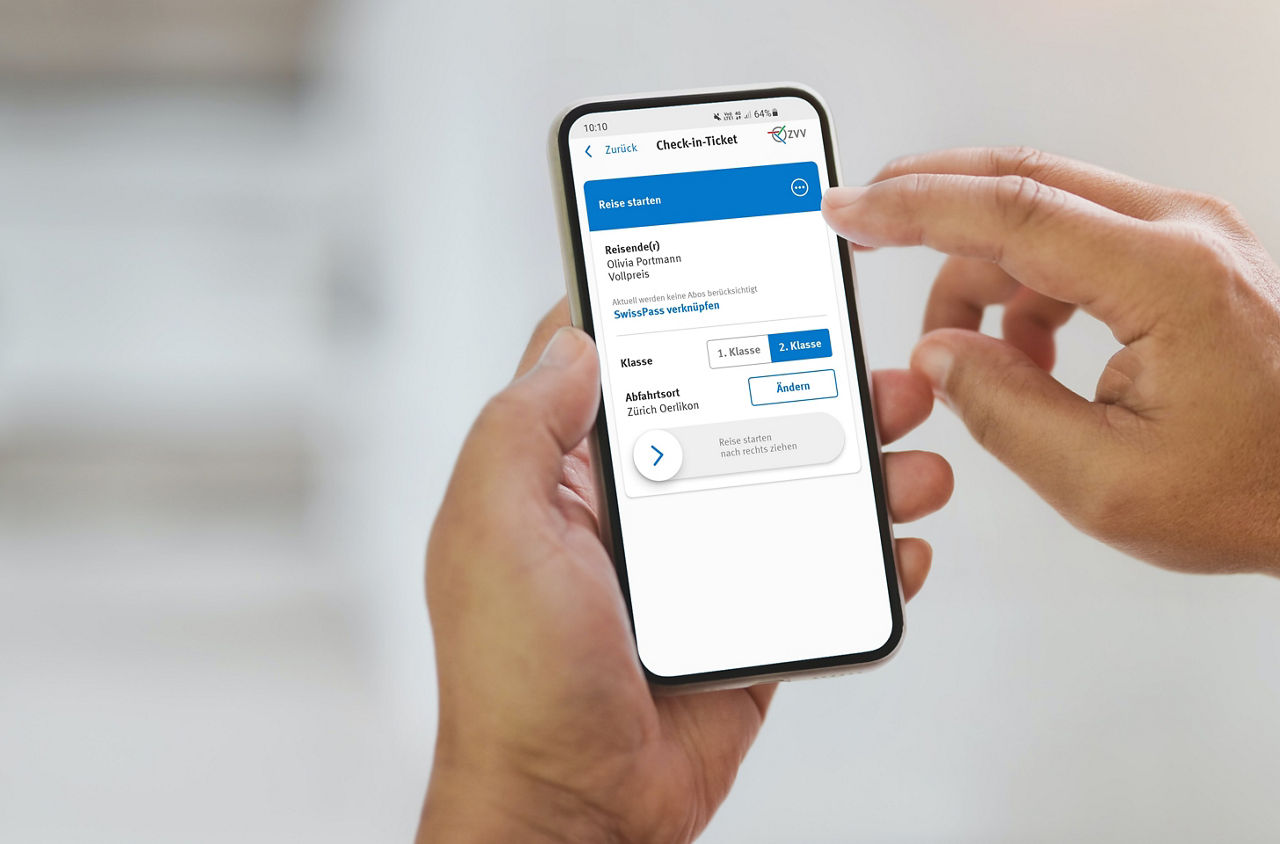
The CICO feature makes it possible for a customer to purchase electronic tickets through a check-in process before boarding the means of transport and a check-out process after leaving the means of transport.
Customers can use the CICO feature for their own journeys with up to eight travel companions. Tickets can also be purchased for dogs or bicycles. Tickets cannot be transferred or forwarded to a different smartphone.
The ticket purchased using the CICO feature is always valid from the time of the check-in process. The ticket expires at the end of the check-out process.
The fare is calculated on the basis of the check-in and check-out data, the collected travel data (geolocation) and the relevant fare regulations of the associations or National Direct Service (NDV) and with consideration for the class of travel chosen by the customer as well as the travelcards referred to on the customer’s personal SwissPass (excluding local network travelcards of the ZVV).
Any number of journeys can be undertaken using the CICO feature in one calendar day.
The cheapest ticket combinations overall are used to calculate the fare for all journeys undertaken on one calendar day, provided that this is possible in accordance with the fare regulations that apply to the journey. This only applies under the condition that the customer undertakes all these journeys using the same log-in details.
The fare calculated for all journeys undertaken on one calendar day shall be billed at the end of the business day and charged directly to the customer by means of the payment method stored in the app.
The traditional information media (such as ZVV app, ZVV website, ticket machines or channels of other transport companies) are available to provide details about prices before or during the journey. Prices can deviate from the indicated fare if the journey undertaken is not the same as the journey in the query.
III. Area of validity and contracting parties
The CICO feature is used to sell Switzerland-wide network tickets, tickets for journeys across different networks and tickets for National Direct Service. The CICO feature includes the ranges approved for the CICO feature by each tariff owner. Super saver tickets are limited and available only in advance. They are therefore not part of the CICO offer.
The contracts of carriage for all journeys undertaken using the CICO feature are concluded between the customer and the transport companies providing the carriage.
IV. Basic fare and tariff information
A) General Provisions
Unless provided for otherwise in these GTC, the latest versions of the fare regulations of the associations and transport companies operating in the area of validity described in section III, including the fare regulations and other provisions set out therein, apply to the purchase of electronic tickets through the CICO feature and the carriage of users.
Furthermore, the General Passenger Tariff (T600) of the Swiss transport companies applies.
The fare information and regulations of the associations and transport companies involved within the area of validity can be obtained from the providers directly (e.g. online or from staffed ticket offices during business hours).
With regard to first-class travel::
- If the user has a second-class travelcard or has already travelled in second class in one zone and (immediately afterwards) then checks in in first class, the user shall be charged a class-up-grade for the zones (covered by the travelcard).
- The billing process automatically takes into account when no first class is available on a means of transport (tram or bus). In this case, the customer shall be charged for a second-class ticket even if the customer selected first class upon checking in.
B) Special provisions in the ZVV
As an exception to the official ZVV tariff, the following special provisions apply to the CICO feature specifically in the Zurich Transport Network area:
- If a journey exceeds the validity period of a single ticket, the user shall be charged for a day pass or connecting ticket that is valid for one calendar day on the basis of the defined billing period. Due to their limited validity, these tickets are 10% cheaper than the existing 24-hour day pass and the connecting ticket for 24 hours in line with the ZVV tariff (T651.8).
- When a ZVV 9 O’Clock Pass is to be paid for, the intended timetable is always of relevance to the defined start of the journey. For technical reasons, journeys starting on a means of transport that is scheduled to depart before 9 am cannot be covered by the 9 O’Clock Pass even if the effective (i.e. delayed) departure was after 9 am. In such a case, the user can submit a request for a review and a refund to customer services (section XI).
- If the journey is not possible on a direct, uninterrupted route based on the timetable within the validity period with a network ticket that is valid for up to two hours, the journey can be continued with a conventional ticket up to the destination (i.e. no surcharge if an inspection occurs; section 3.97 of ZVV tariff 651.8). In contrast, the CICO feature will automatically charge the user for a day pass in these cases as the system does not recognise that a connection is not possible in the timetable within the two hours. In such a case, the user can submit a request for a review and a refund to customer services (section XI).
Furthermore, the CICO feature does not take into account the in-house tariffs of the Polybahn, the Horgen–Meilen ferry or the cooperative society Schifffahrts-Genossenschaft Greifensee. In these cases, the normal ZVV zone tariff will be charged, which is also recognised by these companies.
V. Terms and conditions of use
A) Requirements for purchases
In order to purchase an electronic ticket and use the CICO function, the customer must meet the following requirements:
- They must be in possession of a valid payment method with sufficient funds.
- They must have downloaded the app and installed it on their mobile phone.
- They must be in possession of a functional mobile phone with a non-rooted Android operating system (Google) or a non-jailbroken iOS operating system (Apple) and an activated, functional SIM card that can receive mobile data when the phone connects to a mobile network.
- They must activate location services (high accuracy) on their phone between checking in and checking out at the very least. For, it is necessary for technical reasons to set the authorisation of the location services to "always". Activating power-saving mode is not allowed in general, as it may negatively affect location accuracy.
- They must have permitted the application to access the phone’s built-in motion sensors and to send notifications (push notifications).
- They must maintain a functional data connection during the check-in and check-out processes as well as throughout the journey and ensure that the phone has sufficient battery life for the full duration of the journey. It is not possible to check in or check out without a data connection.
- If it is not possible to check in due to the lack of a data connection or for any other technical reason, the customer must purchase a ticket in another way.
- Turning off the mobile phone, disabling location services, restricting the app’s access, or activating airplane mode while checked in is not allowed and may render the ticket invalid.
The ZVV and Fairtiq reserve the right to exclude individual mobile phone models from use if journey tracking does not function well enough due to the technical specifications of the mobile phone.
The ZVV and Fairtiq accept no liability for any mobile network costs resulting from use of the application.
B) Check-in and check-out
Unlike conventional tickets, the CICO feature operates on the basis of checking in and checking out. When the corresponding button is activated in the application (the check-in process), location tracking is activated and the ticket becomes valid. The application shall then track the journey. When the button is deactivated in the application (the check-out process), the application calculates the distance travelled and the fare, and charges that amount to the stored payment method. The application uses the sensors built into the phone and the software installed on it to determine the location. In order for this to function properly, the customer is obliged to activate or permit the highest possible accuracy of location services on the mobile phone when using the application (GPS and wifi activated), provided that the phone does not prompt the customer to give these permissions when the application is opened. These remain activated and must not be interrupted (e.g., by turning on power-saving mode) until the end of the check-out process.
The period of validity of the ticket begins upon the completion of the check-in process and ends upon the completion of the check-out process. The end of the journey must be confirmed by checking out. If, for technical reasons, the mobile connection is interrupted or the application stops working (e.g. dead battery, system crash, no mobile reception in the area or location services deactivated) during the journey (after the check-in process), an automatic check-out process shall initiate after 15 minutes and the ticket shall become invalid. If the mobile connection can be restored or the CICO feature starts working again within these 15 minutes (e.g. following a system restart), the ticket shall remain valid until the customer checks out.
Activity and location tracking will stop a few minutes after the checkout process is complete. Deactivating the tracking of activity and location data at a later point in time helps to continuously improve the checkout warning and thus to optimise the services provided by Fairtiq to the customer. The location data collected after the checkout process is completed will only be used by Fairtiq in an anonymised format. The mobile phone location services activated at the time of the customer's login must remain activated between check-in and check-out.
Immediately before boarding the means of transport at the stop or station, the customer must use the app on their phone to check in. The customer must check in before boarding the means of transport. The customer must ensure that the chosen class corresponds to the setting in the application. Check-in processes to purchase an electronic ticket that are completed after the customer has boarded the means of transport are invalid. Likewise, a ticket inspection shall find the electronic ticket invalid in this case and the customer shall count as someone travelling without a valid ticket.
When checking in, the customer must allow additional time for the purchase if the network bandwidth is low (e.g. EDGE, E, GPRS).
The application will confirm that the check-in process has been completed successfully and the ticket is valid on the mobile phone display.
If check-in is not possible for technical reasons, a notification will be shown on the mobile phone’s display. In this case, the customer must purchase a valid ticket elsewhere or the customer shall count as someone travelling without a valid ticket.
Immediately after the end of the journey, after the customer has exited the means of transport, the customer must check out at the stop or station. The validity of the ticket expires upon the completion of the check-out process. If the customer has to change the means of transport in order to continue their journey, it is not necessary to check out during the change as long as both journeys are undertaken within the perimeter of the GA Travelcard. It is only necessary to check out at the end of the entire journey within the area covered by the GA Travelcard. It is the customer's responsibility to check out on time. Fairtiq and the ZVV accept no responsibility for costs incurred by the customer as a result of not checking out on time.
If the application calculates, using the sensors built into the mobile phone, that the customer is presumably no longer on the journey and has not yet checked out, the application will send a warning message to the mobile phone, informing the customer that he/she may have forgotten to check out. The customer must allow notifications on their phone for the warning to be displayed. The customer is still responsible for checking out. If the check-out warning does not appear or appears at the wrong time, this does not affect the customer's responsibility to check out at the correct time.
If the customer was unable to check out at the end of the journey for technical reasons, the customer must immediately contact the ZVV customer service (ZVV-Contact) and provide the route, the location and time of the end of the journey and the journey number. The same applies to any and all complaints.
C) Smart Stop
The “Smart Stop” feature allows the app to perform the check-out process automatically under certain conditions. The customer can choose to enable or disable this feature within the app.
The customer receives a notification on their mobile device as soon as the app detects that the journey on public transport (PT) has ended. Tapping the notification opens a timer showing the remaining time until the automatic check-out is performed. If the customer plans to continue traveling on public transport, they can manually pause the timer by tapping the corresponding button in the notification. In this case, the journey recording will continue. If the timer is not manually paused, the check-out process will be automatically initiated when the timer expires, and the ticket will become invalid.
To use Smart Stop, the customer must allow notifications on their mobile device and have an active data connection.
The check-out process remains the responsibility of the customer. If Smart Stop is activated, the customer is responsible for pausing the timer in time to ensure that the ticket remains valid, provided they have not yet completed their journey on public transport.
D) Ticket inspection
All electronic tickets are registered electronically and centrally by Fairtiq. An electronic copy of the ticket is sent to the customer's mobile phone. The customer may not delete the electronic copy of the ticket before the end of the journey. Similarly, the customer may not transfer or send it to another mobile phone.
The customer must present the mobile phone and the electronic ticket to the inspector and, if asked to do so, show the inspector all inspection elements (via the ticket button) and all display levels (e.g. detailed display). The inspector is entitled to check the ticket multiple times per journey.
At the request of the inspector, the customer must relinquish the mobile phone for inspection. The inspector is entitled to use the mobile phone to conduct a standard check. The customer must follow the instructions of the inspector.
The smartphone should have default values set for font styles, font type and font size for ticket inspection purposes. The customer risks e-tickets or parts of them being illegible if settings are different.
If the customer is unable to present the electronic ticket with all display levels and all inspection elements, or if an electronic ticket cannot be checked because the mobile phone has not been updated, is malfunctioning, has an illegible display or the font is illegible, the customer shall be treated as someone travelling without a valid ticket. Electronic tickets cannot be presented subsequently.
E) Travelling without a valid ticket
If the customer is unable or unwilling to present a valid electronic ticket that can be checked, the customer shall count as someone travelling without a valid ticket. The customer will be required to pay a fee in accordance with the applicable fare rules.
F) Misuse or falsification
In the event of misuse or falsification, the provisions of the applicable tariff shall apply. The ZVV reserves the right to block customers suspected of misuse from using the CICO feature if they do not desist from the fraudulent behaviour in question despite being requested and warned to do so. This block applies system-wide, i.e. to all domains using the Fairtiq app.
If you have any queries or objections regarding a block or warning for fraudulent behaviour, please contact the Fairtiq fraud department (fraud@fairtiq.com) or our customer service ZVV-Contact (contact@zvv.ch).
G) Billing
The billing period for journeys made using the CICO function is each calendar day until the close of business. Journeys shall be billed at 5 am on the following day.
The ZVV and Fairtiq must be able to charge unpaid past journeys to the payment method specified by the customer. If the ZVV and Fairtiq are unable to charge the customer for past journeys, the customer will be blocked from using the CICO function. The block can only be lifted by successfully charging the past journeys to a valid payment method.
H) Changes, exchanges and refunds
Electronic tickets purchased in the app cannot be changed or exchanged.
If the customer realises after the journey that he/she has been charged the wrong tariff in the application, he/she must notify the ZVV customer service within 12 months of the date of the journey. If the ZVV customer service comes to the conclusion that the customer has been charged the wrong tariff and that the customer is not responsible for this, the difference between the incorrect tariff and the correct tariff will be refunded to the customer. The ZVV is not obliged to refund the fare or part of it if the customer does not check out on time or does not check out at all.
VI. Liability
The customer uses the CICO feature exclusively at their own risk. In particular, the customer must personally ensure that their mobile phone cannot be accessed by any unauthorised third parties.
To the extent permitted by law, Fairtiq and the ZVV disclaim all liability for the content, functionality and use of the application, including liability for malware.
If the application cannot be used or an electronic ticket cannot be purchased for technical reasons, Fairtiq and the ZVV reject all liability for any and all resulting damage. The malfunctioning of the application does not in any way entitle the customer to travel without a valid ticket.
VII. Data protection
The data privacy statement of the Zurich Transport Network (ZVV) applies and is available at www.zvv.ch/datenschutz.
The most important information regarding data processing in connection with the CICO feature is provided below.
A) Processed data
General information about the customer (customer data):
- First name, surname and date of birth
- Mobile phone number and email address
- Device information (make and model, operating system, network operator, battery level as well as WiFi an beacon signals)
- Information about Travelcards
- User ID and IP address
Travel data:
- Location and movement data that are collected shortly before the customer checks in (as soon as the app is in the foreground) and for a few minutes after the customer checks out.
- Route and price information that is calculated on the basis of the collected location and movement data as well as travel options (the scheduled timetable).
Purchase data:
- Route/zone, date/time
- Product and price, including class of travel (first or second class)
B) Purposes and methods of processing
Personal and travel data shared by the user with Fairtiq will be processed by Fairtiq exclusively for the purpose of issuing electronic tickets, especially to purchase and process, calculate and bill the relevant journeys, for customer service purposes and to prevent misuse and detect journeys that have been undertaken unlawfully.
Anonymised travel data is used to improve public transport services and fares, to improve and optimise the application and the associated services as well as for statistical analyses.
C) Storage of Data
Customer data is generally stored in Fairtiq for 12 months and then deleted. Travel and purchase data is stored for 12 months after the end of the journey for customer service purposes. The data is then anonymised to prevent it from being associated with customers for a further period.
In cases of misuse (see section V(E)), all data relating to the blocked customer will be stored for 24 months after the last trip. After this point it will be deleted or anonymised.
D) Access to data
The Customer may request access to his/her detailed travel data. To do so, the customer must send a request to the ZVV Customer Service by e-mail (contact@zvv.ch) or by post (ZVV-Contact, 8040 Zurich), enclosing a copy of an official form of identification.
E) Erasure of data
The customer is entitled to demand the erasure of their travel and other personal data at any time unless the customer has been blocked from using the feature due to misuse or the ZVV needs the data in order to exercise its rights.
By submitting the request for erasure, the customer expressly waives their right to make use of customer services and file complaints about their journeys.
VIII. Licence
In their relationship with the customer, the ZVV and Fairtiq retain all rights to the application.
By registering the customer in the ZVV app, Fairtiq grants the customer a licence to use the CICO feature for its intended purpose. It is prohibited to make copies, grant sublicences or transfer other rights to the application to third parties in any other way. Neither the content of the feature nor the material on which it is based and which represents a part of element of the content may be modified, distorted, adapted, deconstructed or corrected.
IX. Termination
The ZVV and Fairtiq are entitled to terminate the licence agreement with the customer at any time and to withdraw their service from the market. In particular, the ZVV and Fairtiq reserve the right to block individual customers in justified cases.
The ZVV and Fairtiq reserve the right to block customers without giving reasons and to notify the customers electronically. The ZVV is not obliged to inform the customer.
X. Applicable law and place of jurisdiction
This agreement is exclusively subject to Swiss substantive law, to the exclusion of private international law.
The exclusive place of jurisdiction for all disputes between the ZVV and the customer is Zurich (Canton of Zurich).
XI. Questions and support
If you have any questions about the CICO feature, please contact the ZVV customer service (ZVV-Contact: 0800 988 988/contact@zvv.ch).
XII. Downloading the GTC
The currently valid version of these GTC can be viewed at www.zvv.ch/check-in. The T&C can be downloaded, saved and printed out from there.
Valid as of March 2026